1993
Found around a problem
NVIDIA begins with the belief that visual computing requires a new architecture before a large market is obvious.
3 source(s)Jensen Huang · NVIDIA Co-founder and CEO
NVIDIA is not the result of one bet on AI. It is a system built over more than thirty years to choose hard problems, learn before the market, and move information faster than hierarchy.
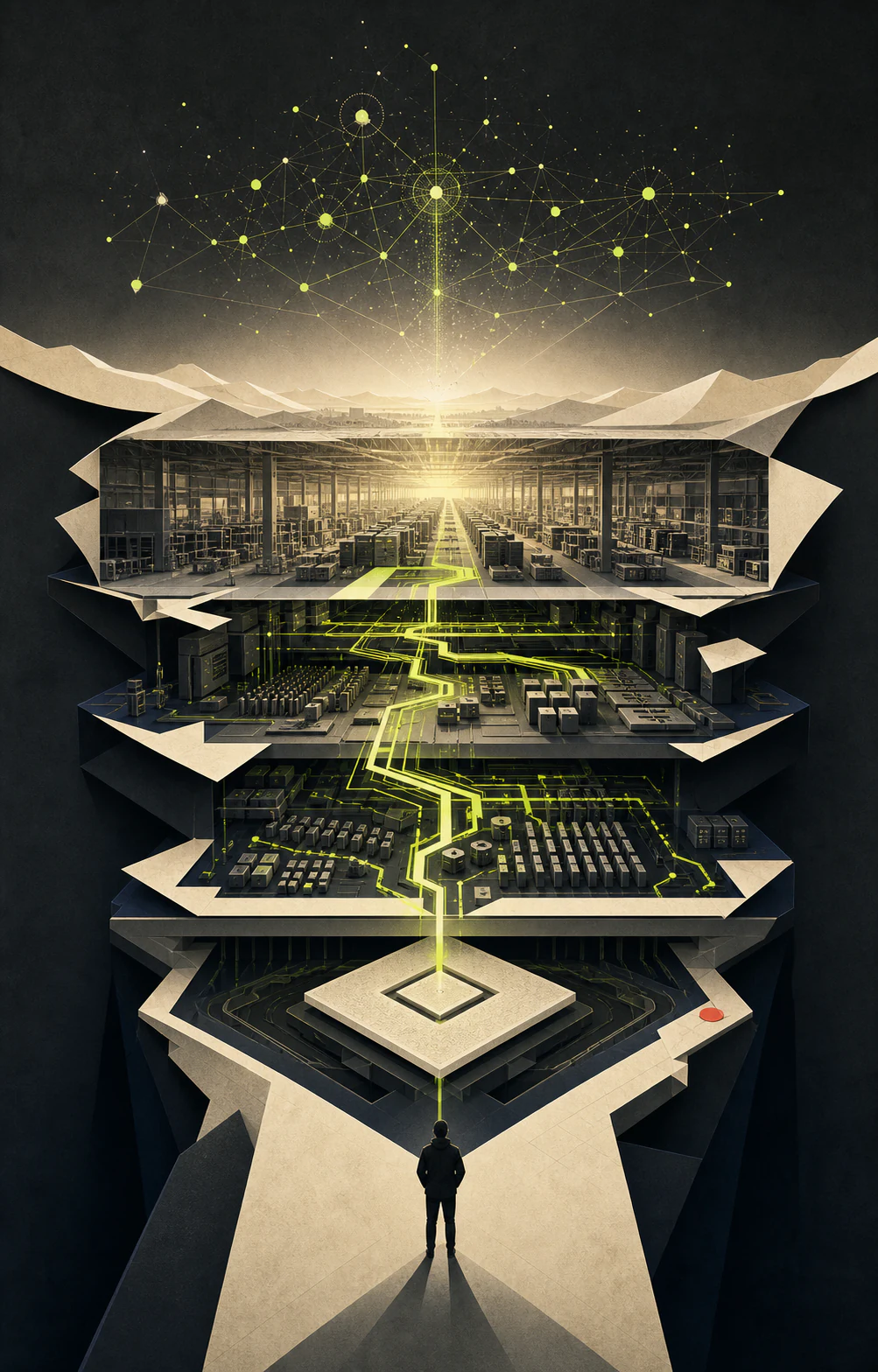
Foreword · Ooléle Special
No single interview can explain NVIDIA. The same episodes change meaning when Jensen Huang tells them in 2011, before the generative-AI boom, and in 2026, when GPUs, CUDA, and data centers have become global infrastructure.
This Special compares 14 conversations retained from 20 candidates—18 hours and 20 minutes of material published across fifteen years. Each source was transcribed and analyzed independently before repeated anecdotes were merged and chapters were built. The result is neither a complete biography nor a celebration of NVIDIA. It looks for mechanisms: how to choose a problem that can endure, survive a wrong architecture, finance a ten-year bet, circulate context, and move from a chip to a complete system.
Wording directly attributed to Huang remains connected to its original passage. Syntheses are labeled as such. Each lesson’s discreet badge opens the excerpts, dates, timestamps, and YouTube links needed to verify the source without turning the page into a transcript.
Before NVIDIA, there is no lone-genius story yet. There is a young engineer learning to serve, to repeat a craft until it becomes instinct, and to observe the world from a position that can never be universal.
Those experiences do not mechanically explain what came later. They reveal components of an operating system: choose what deserves your time, stay close to real work, and match an ambition with capabilities the team has actually earned.
In Kyoto, Jensen Huang watched a gardener patiently tend an immense moss garden. Asked how he could ever finish, the gardener answered that he had plenty of time. Huang took from the scene less a productivity technique than a way to narrow the field: care for the patch in front of you as though it were the only important task.
The practice creates no extra hours. It removes low-value commitments and concentrates attention on chosen work. Intensity then becomes the consequence of an explicit priority, not permission to fill every minute or evidence that everything can be pursued at once.

At Denny’s, Huang moved from washing dishes to waiting tables. He learned to finish a task completely, prepare the station for the next shift, and understand that service balances a guest’s experience with the restaurant’s economics. The setting was ordinary, but the feedback was immediate: a table was ready or it was not.
Decades later, he connected that work to leadership close to the details. Reviewing a document is not useful because no task is beneath a chief executive; it matters only when the review improves someone else’s reasoning. Operational proximity becomes an act of service, not a license to control every decision.

In 2011, Huang preferred the word “perspective” to vision. A perspective comes from a position, a set of experiences, and problems someone has learned to see. It is therefore not reserved for a few celebrated visionaries: anyone can develop an angle that makes a different future visible.
The same definition sets a boundary. Huang recalls seeing the potential of video games early while missing the significance of Yahoo. Being right about one transformation grants no general foresight. The useful practice is to exploit a distinctive angle while actively searching for what it excludes, especially once success begins turning an old insight into a legend.

When Huang, Chris Malachowsky, and Curtis Priem considered starting a company, they did not begin with a promising market alone. They looked for a problem suited to what they could genuinely combine: graphics, computer science, system design, and chip building. The ambition became credible because it met a precise collective capability.
That choice is stricter than a loose idea of founder-market fit. A team must distinguish a field it understands from a problem its intersecting skills let it solve differently. A grand mission without that intersection remains a slogan; expertise without an important problem produces an isolated feat. NVIDIA began in the tension between the two, not from either one alone.

A company can change products without losing its axis if it defines the problem before the solution. For NVIDIA, that axis became computation that general-purpose machines could not perform efficiently.
Video games supplied the first economic engine, but the architecture already reached further: create the market with the technology, earn trust before the pitch, and protect software across successive generations of silicon.
When NVIDIA was founded, the team did not state its mission as “make a graphics chip.” It wanted to build computers able to solve problems beyond general-purpose computing. Graphics was the first expression of that idea, not its permanent boundary.
This wording gave the company permission to change products without rewriting its identity at every transition. It does not mean AI, biology, or robotics were predicted in 1993. It establishes a more durable test: find workloads for which another architecture becomes necessary. The mission guides exploration; the markets remain discoveries, not prophecies reconstructed after success.

In the early 1990s, Huang saw video games becoming a mass industry while older investors saw little demand. The bet was to reinvent for consumer machines graphics previously available only on expensive workstations. That market became demanding enough to pull the technology forward.
Gaming was therefore more than NVIDIA’s first source of revenue. Its users continually wanted more realism and performance, financing rapid architectural generations. The lesson is not to choose an entertaining market; it is to find an initial use whose economic and technical appetite can drive an engine much larger than the first destination.

Acceleration technology has no value in isolation. Without suitable algorithms, nothing useful runs; without developers and applications, buyers see no market; without demand, technical investment runs out. Huang describes this knot as a chicken-and-egg problem that must be solved simultaneously.
NVIDIA therefore had to build more than a component: tools, a developer base, applications, and distribution. That capability appears in gaming, then scientific computing and deep learning. It cannot guarantee that a market will emerge. It does turn adoption into explicit design work instead of waiting for the world to understand an invention on its own.

Huang admits his first business plan was incomplete and his pitch unconvincing. Yet Wilfred Corrigan, his former leader at LSI Logic, called Don Valentine and recommended funding the team. That call did not replace analysis of the venture; it gave weight to people who would have to navigate what the plan could not predict.
Across interviews recorded thirteen years apart, the mechanism is consistent: investors can learn a market, but first they must trust the team’s judgment and character. Reputation is not a personal brand assembled for a fundraise. It is the accumulated trace of difficult work completed before anyone needs to borrow against it.

From the beginning, NVIDIA tried to separate software investment from accelerators that changed every generation. A shared architectural layer gave developers a stable target while the silicon evolved behind it. Software written today could reach tomorrow’s machine without starting over.
Compatibility creates a compounding effect: every new chip inherits applications, skills, and trust already invested in the platform. It also places a severe constraint on NVIDIA, which cannot optimize one generation by casually breaking the last. A platform is not merely proprietary technology; it is a promise of continuity made to developers and kept across multiple hardware cycles.

NVIDIA’s survival is not merely a story about courage. Its original architecture was genuinely misaligned with developers and with the standard Microsoft was establishing across the market.
The escape required four separate decisions: admit the error, choose the correct technical path, tell Sega the truth, and turn an impossible deadline into a testable design method.
NVIDIA’s first architecture saved scarce memory through clever technical choices: curved surfaces, forward texturing, and no Z-buffer. On paper, it was efficient. In developers’ hands, it made their ideas hard to express just as DirectX was establishing a different standard.
The crisis shows that a platform does not win a contest for the cleverest architecture. It wins when creators can understand its constraints, realize their imagination, and reach users. Cost or performance cannot permanently compensate for a poor development experience. Internal elegance must therefore be judged from the outside: by what it actually enables other people to build.

Once DirectX became the standard, NVIDIA could no longer treat architecture, the Sega contract, financing, and differentiation as separate issues. Every consequence appeared to block the next decision. Huang’s sequence was to begin with the foundation: adopt the correct technical path even when it immediately exposed every other problem.
The sequence does not reduce the risk. It prevents a commercial constraint from justifying a product the team knows is wrong. After choosing the right direction, NVIDIA still had to differentiate, renegotiate the contract, and find time. Reversing the order protects nothing: it preserves all the consequences while removing the possibility of building a viable answer.

Abandoning the architecture also doomed the project promised to Sega. Huang told the company’s leader that continuing the contract would harm both sides. He asked to be released from it, then added an apparently contradictory request: still provide the payment, without which NVIDIA would disappear.
The moment combines responsibility with vulnerability. Telling the truth protected the partner from a delivery known to be wrong; asking for help admitted that candor alone could not save the company. Sega agreed. The lesson is not that honesty will always be rewarded. It is that a leader in crisis must make the dilemma explicit, own their part, and let the other party decide with full knowledge.

After the reset, NVIDIA had roughly nine months and could afford only one tape-out. Instead of estimating how long the conventional method required, the team began with the fixed deadline and asked what work system could make the result possible. It acquired an emulator headed for scrap and ran the chip with its software stack before silicon existed.
The famous “bet the company” moment becomes more than an act of faith. NVIDIA pulled forward every future risk it could simulate, test, or prepare, then launched production, software, and market work together. Commercial uncertainty remained; technical uncertainty had been attacked in advance.

CUDA cost money before it earned any. The platform added expense to gaming chips while applications able to pay for that capability did not yet exist.
The patience was neither passive nor blind: follow unexpected users, measure the slope of progress, distribute CUDA through GeForce, and finance the wait with small markets.
Before CUDA, doctors used the graphics language CG for CT reconstruction; a computational quantum chemist expressed algorithms with it; others explored seismic processing. The uses were small, strange, and distant from the core market. Huang traveled to understand why the tool mattered to them.
The signal did not come from a survey asking customers which chip to buy. It came from people repurposing a capability to cross a real constraint. NVIDIA did not conclude that a large market was guaranteed. It discovered that a programmable graphics processor could become something else. Frontier users do not predict market size; they reveal the direction of a technical possibility.

To serve science, the GPU had to open up: more algorithms, a familiar language, and enough flexibility for unexpected domains. Yet if it became merely a general-purpose processor, it would lose the performance, energy, and cost advantage that made acceleration worthwhile. CUDA moved along that narrow line.
The compromise was not solved once. Accounts from 2011 and 2024 describe the same tension after very different degrees of success. Every expansion of scope must preserve useful specialization. The platform wins not by removing all constraints, but by deciding which constraints keep it fast and which ones to abstract so developers can invent.

When a market does not exist, margin and revenue are late results. Treating them as the only indicators forces a company either to quit too early or persist without evidence. Huang looks for earlier signs: an important problem newly solved, researchers returning, papers arriving faster, and capability improving from one iteration to the next.
Those signals are weaker than a sale and can be misread. Their value lies in trajectory: present usefulness may be limited, but the rate of improvement reveals whether the future is approaching. Measuring the slope makes a long bet falsifiable. The question becomes not only “is it large already?” but “does each cycle make the thesis more true?”

CUDA did not yet have its decisive application, but GeForce already had global distribution. By placing computing capability inside gaming products, NVIDIA put it into the hands of gamers who were also students, researchers, scientists, and PC builders. The profitable product of the present carried the uncertain platform of the future.
The choice reduced a classic obstacle: a new platform without an installed base attracts no developers, and without developers it creates no uses. Yet it imposed an immediate cost because every chip carried capability the market did not value yet. Distribution was therefore a strategic investment financed by the existing franchise, not a channel added after invention.

Developers do not join a platform merely because it performs an impressive demonstration. They invest time when their software can reach many users. CUDA’s installed base reduces that risk: a new tool, library, or application already has machines capable of running it.
Scale alone is insufficient. A developer also bets that NVIDIA will preserve compatibility, improve the platform, and not strand the investment during the next cycle. The moat is therefore relational as well as technical: a reachable audience, accumulated habits, and confidence in the steward. Breaking that promise could destroy more value than shipping one weaker hardware generation.

CUDA added cost to chips while no large application paid for the capability. The bet on a zero-billion-dollar market therefore damaged the economics of the gaming market funding the company. Waiting passively for AI would have made the platform unsustainable long before its breakthrough.
NVIDIA searched for narrower footholds: CT reconstruction, seismic processing, and molecular dynamics. None was the hoped-for large market, but each produced revenue, technical feedback, and a reason to continue. Those small wins formed a survival portfolio. They did not yet prove the final thesis; they bought time for researchers, software, and hardware to improve together.

To decide today in an industry with long cycles, Huang imagines the desired world ten years ahead and looks backward. Which capabilities should have begun earlier? Which tools, skills, or partnerships will be missing if nobody acts now? The method avoids mechanically extending the current product.
Looking from the future is not a precise forecast. It exposes dependencies that already require commitment, especially when hardware must be designed before software settles. The discipline works alongside field signals: the horizon supplies direction, while successive evidence corrects the route. Without that revision, the imagined future would become only a story the company refuses to abandon.

At NVIDIA, speed does not come from processors alone. It also depends on how far information must travel before someone can understand it, challenge it, and act.
This organization remains unusually founder-led. The useful task is not to copy its org chart, but to isolate the mechanisms: test convictions, share context, expose reasoning, and preserve tacit knowledge.
In 2011, Huang described intellectual honesty as continuous reassessment: accept risk, but leave a dead end quickly once its premise stops making sense. In 2024, he applied the same test to a period when NVIDIA’s stock price collapsed. The price had changed; he asked whether the physics, assumptions, or problem had changed with it.
The rule is neither “always persist” nor “pivot whenever the market panics.” It separates an external signal from the causal mechanism. If the core belief is falsified, change quickly. If it still survives the evidence, volatility alone is not a sufficient reason to abandon the work.

Huang compares building a company to building a machine: its shape should follow its inputs, outputs, speed, and operating environment. NVIDIA therefore describes its organization as a computing stack, with capabilities connected around the system being produced rather than a ready-made command hierarchy.
The internal phrase “the mission is the boss” does not remove responsibility. It changes the starting point: identify the problem, then assemble the people and resources able to solve it, even across functions. Copying the number of direct reports would miss the mechanism; the architecture has to remain specific to the actual work.

Huang rejects an organization where exclusive access to information justifies rank. His alternative is to distribute context broadly, including difficult news, so thousands of local decisions remain aligned without sending every judgment back to the top. Transparency becomes coordination infrastructure.
It does not make every opinion equivalent, nor does it erase confidentiality or accountability. In his model, authority has to be earned elsewhere: through reasoning in complexity, inspiring people, supporting them, and enabling their success. Sharing information removes an artificial privilege while raising the standard of judgment expected from leaders.

Giving people a conclusion leaves them to obey it or reject it whole. Huang prefers to expose the steps that produced it. A colleague can then catch a weak assumption before the error becomes a decision inherited by the entire team. Public reasoning shortens the correction loop.
He applies a similar logic to feedback: one person may have made the mistake, but the learning can belong to the group. This is not a license for public humiliation. It requires a setting where criticism addresses the work and its premises, people can respond, and visibility builds shared capability rather than shared fear.

Huang says he avoids recurring operating meetings because capable leaders already run them. He instead describes the chief executive as a pinch hitter: someone who enters a stuck project, an idea without an obvious owner, or a problem that nobody else can yet solve.
This filter protects a scarce resource: attention at the top. A reporting meeting can consume that attention without changing the work. But the principle must not become permission to bypass teams. If the chief executive becomes the required solution to every difficulty, the organization recreates the exact bottleneck this practice is meant to remove.
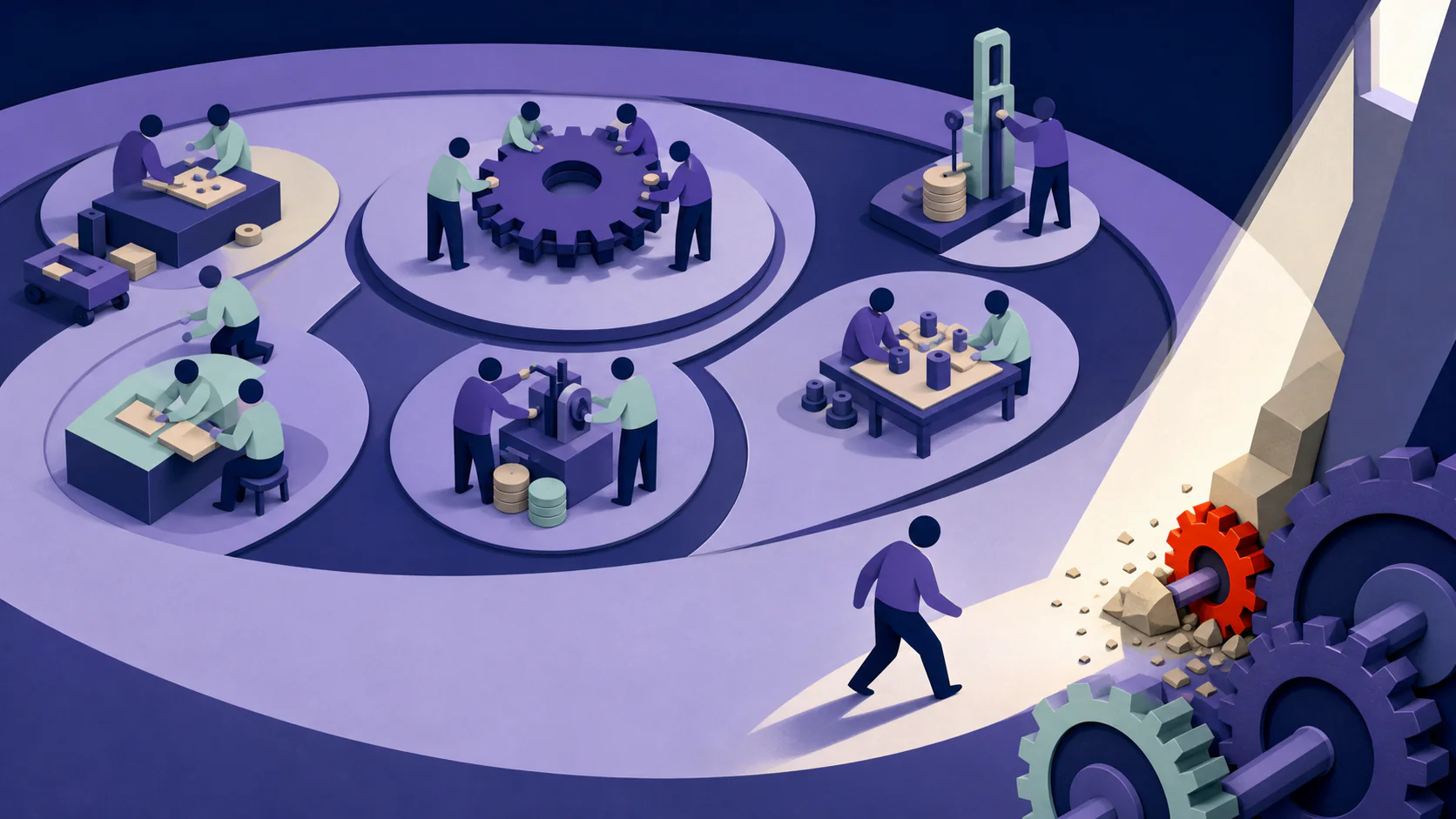
Processes make work repeatable, but Huang distinguishes operational excellence from the care required for extraordinary work. A team that moves through mistakes, successes, and product cycles together accumulates shortcuts of understanding, trust, and memory that no procedure can fully describe.
Tenure therefore becomes a form of institutional storage. Losing a whole group does not merely mean replacing roles; it erases relationships and reflexes whose value rarely appeared in a document. This is not an argument for stagnation or weak performance. It is a reminder that rebuilding a team carries an invisible cost, and that craft is also composed over time.

A very fast accelerator does not solve a problem when networking, memory, energy, cooling, or the unaccelerated part of the software becomes the next obstacle.
The real product therefore expands to the entire system. Because hardware is decided years before use, co-design must also read software signals and align suppliers before demand becomes certain.
Extreme co-design becomes necessary when the problem no longer fits inside one computer. Distributing the computation across many machines brings algorithms, models, data, networking, memory, power, and cooling into the same equation. The performance of one component no longer describes the performance of the complete job.
Huang invokes Amdahl’s Law: dramatically accelerating a small portion leaves the remainder to limit the result. Advantage therefore moves to finding and removing the next bottleneck, even when it sits outside the company’s historical specialty. Co-design is not an accumulation of parts; it is optimization of the entire path taken by a workload.
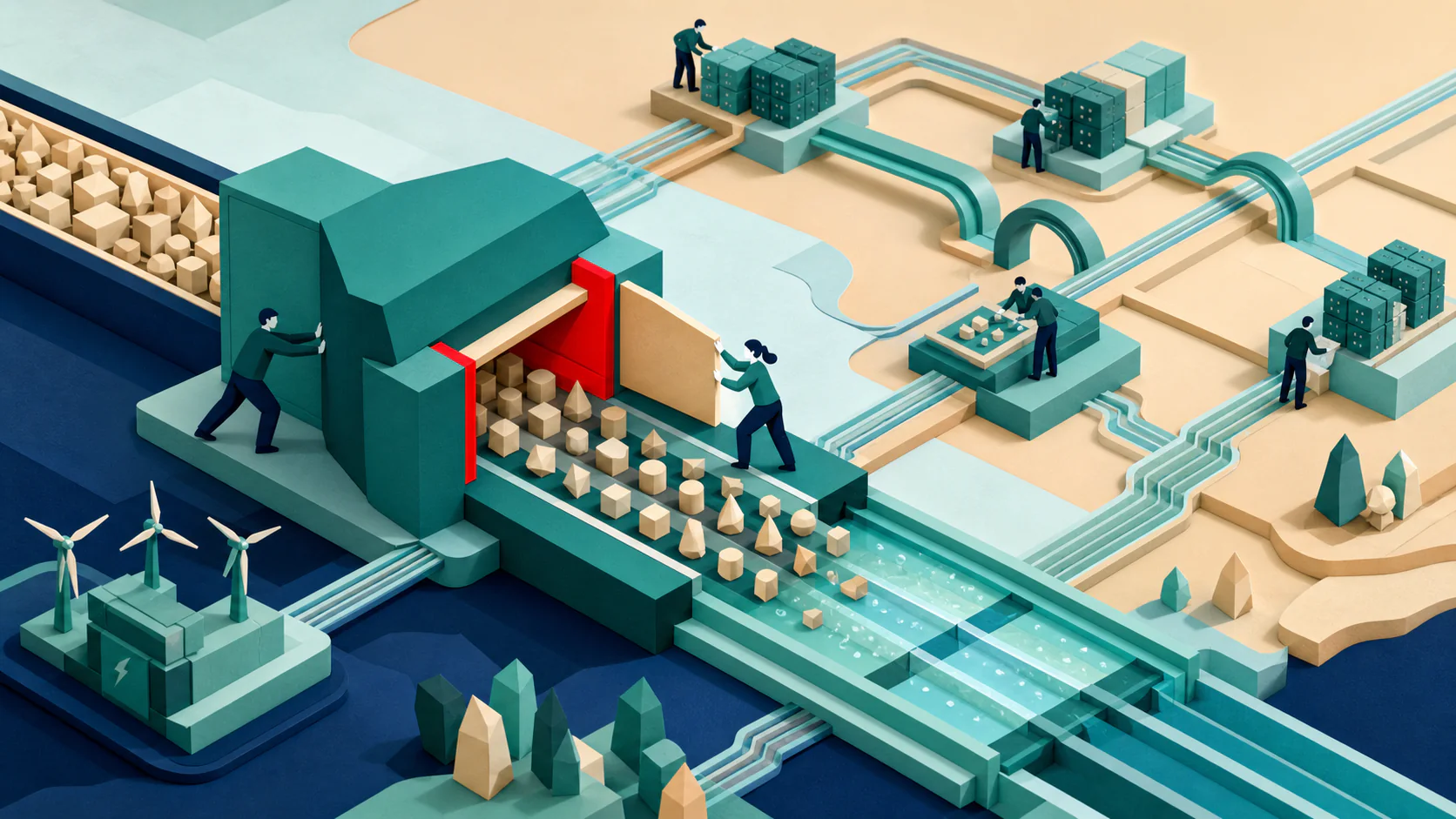
A fully fixed-function component can be extremely fast today and useless after the algorithm changes. A completely general architecture adapts easily but gives up part of the energy and speed advantage acceleration is meant to create. CUDA deliberately occupies this unstable frontier.
The choice is not specialization or flexibility, but how much programmability can preserve both. That balance must be revisited as model architectures evolve. It also explains why a single benchmark is insufficient: a platform’s value depends on current performance and on whether it can absorb the next algorithm without forcing developers to start again.

Models can change within months while a hardware system takes years to build. Waiting for the market to settle would therefore make the next product target the past. NVIDIA narrows that gap by conducting its own research, building models, and observing work at the frontier.
Around 2012, independent requests from several deep-learning labs supplied a more useful signal than an already named market category. They did not prove that every AI thesis would succeed. They showed multiple researchers bending the same architecture in a new direction through real experiments. Hardware forecasting thus becomes a discipline of listening as much as engineering.
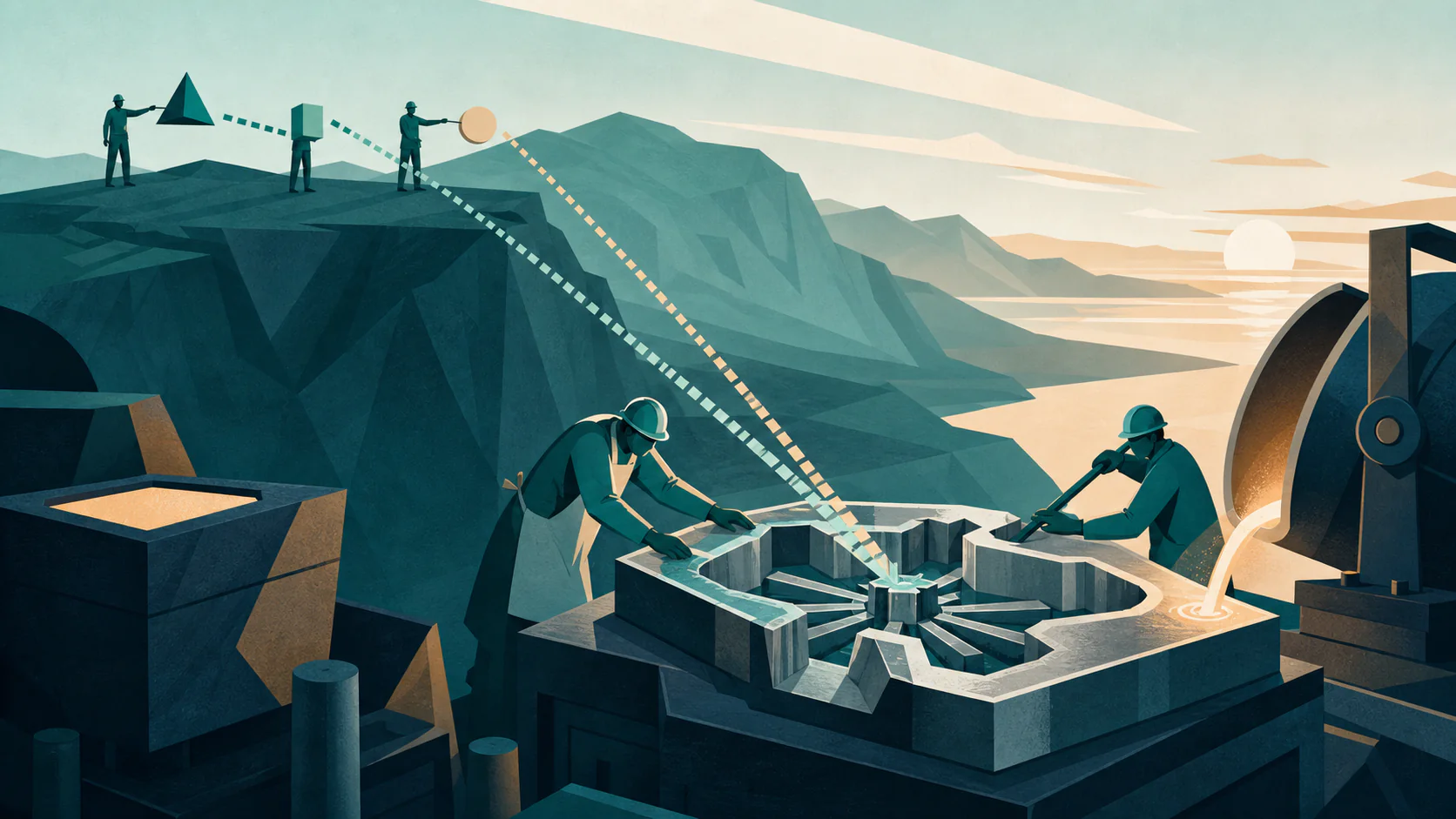
An AI factory depends on memory, networking, energy, and manufacturing capacity that NVIDIA does not control alone. Once demand becomes obvious, it may be too late for partners to build lines, hire people, or reserve the required materials. The supply chain must understand the future before it can measure it.
Huang describes keynotes and supplier-CEO conversations as a form of coordination. He explains growth drivers, draws the architecture, and invites partners to challenge the reasoning. The requested belief cannot rest on prestige or urgency; it has to be earned through testable explanations, durable relationships, and a view specific enough to support investment.

“AI factory” can sound like a slogan. It becomes useful when it describes two measurable changes: infrastructure now produces a computed output, and its economics depend on the complete system.
The relevant comparison is therefore the cost of useful output under a power constraint, why generation requires continuous computation, and the five industrial layers that make that output possible.
The history is not simply a chain of commercial wins. NVIDIA began with an observation about parallelism, made the GPU programmable through CUDA, then treated AlexNet as evidence that a computer could learn functions instead of receiving every rule by hand. Each step widened what the architecture could make economically reachable.
Huang now frames this movement as a transition from sequential general-purpose computing toward accelerated and AI computing. That is a strategic thesis, not the immediate disappearance of CPUs or conventional software. The more useful test is narrower: which workloads become possible or affordable when hardware, algorithms, and learned software are designed together?

A chip’s price is not enough to describe the economics of an AI system. The buyer has a fixed envelope of power, space, networking, and time. The relevant question becomes: how much useful output can the infrastructure produce inside those limits, and how much conventional equipment must remain around it?
A more expensive machine can therefore lower final cost when it replaces more equipment or produces more from the same power. The opposite can be true for another workload. This method keeps a claimed technical advantage from becoming a universal truth: compare total cost, real utilization, and output quality, not only the component or a selected performance multiple.

Efficiency lowers the energy cost of one task, but it does not guarantee lower total demand. Software is changing too: a file was written once and retrieved, while a generative system can compute every response, reason longer, consult sources, and keep multiple agents running continuously.
As each unit becomes cheaper, more uses cross the economic threshold: new modalities, additional users, or work that was previously too expensive. Huang therefore expects useful volume to grow faster than efficiency. This is a forecast, not an automatic law. It must be tested against real consumption, because lower unit cost can coexist with a larger total footprint.

Huang says a chip is no longer his mental model of the product. Delivered value now depends on an installed whole: accelerators, CPUs, memory, networking, cooling, software, racks, and the teams able to bring everything online. The unit of design and accountability has moved to the complete factory.
That shift forces the organization to own interfaces a component supplier could once leave to the customer. It also makes industrialization central: an exceptional machine becomes infrastructure only when it can be manufactured, deployed, and operated repeatedly. Saying “the factory is the product” does not erase the components; it evaluates each one by its contribution to the useful system.
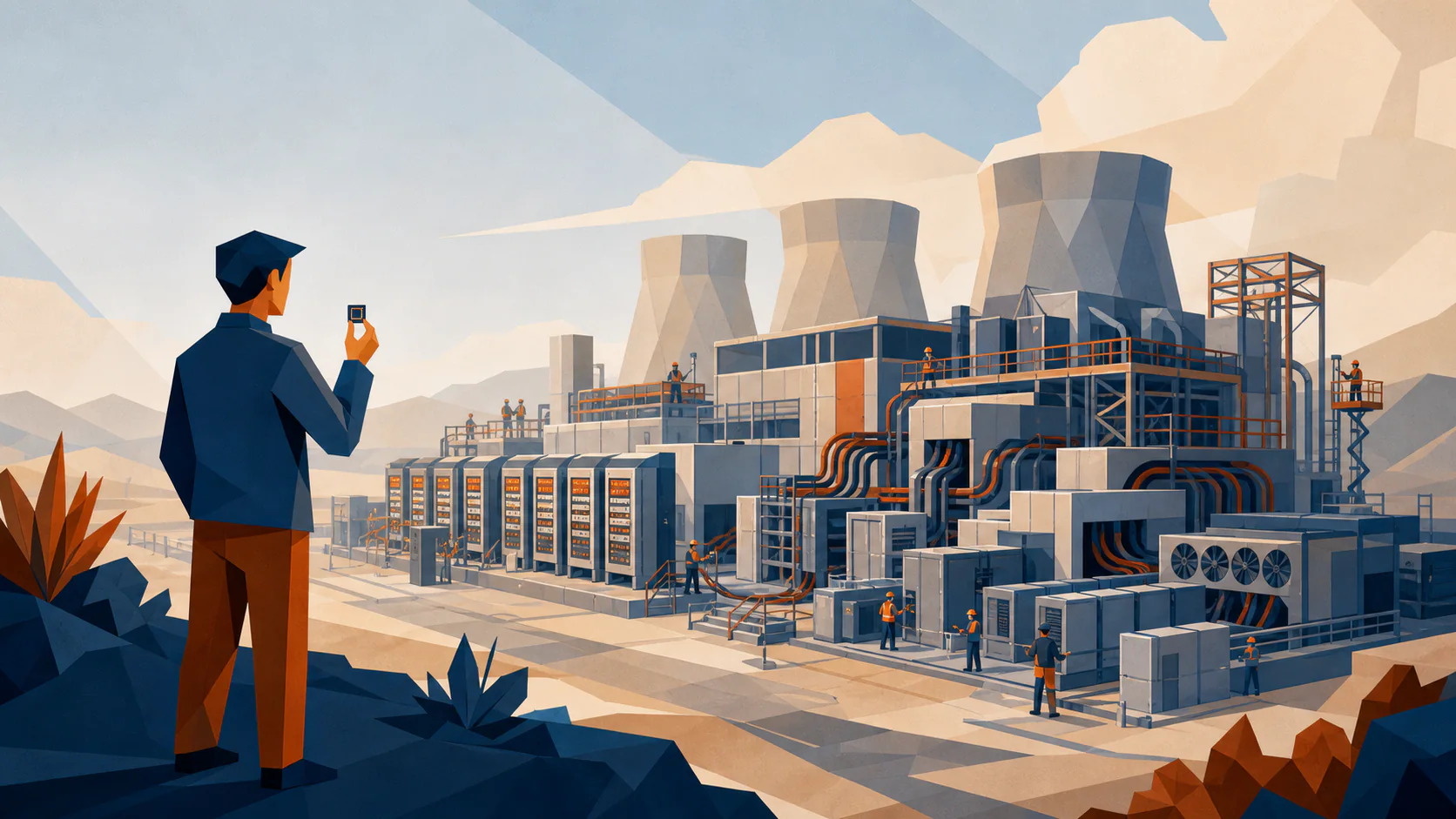
For decades, much of computing meant storing a prepared file and retrieving it later. A generative system instead produces a new output for a present request and context. Every result uses computation when it is requested, moving the critical resource from storage toward production.
Huang draws an economic analogy: the data center looks less like a warehouse and more like a factory whose output can be sold or embedded in a service. The analogy guarantees no value. A generated result has economic worth only when it is reliable and useful. It does explain why the use of computation can now track activity and revenue more directly.

The visible chatbot is only one layer. Huang describes a five-level economy: energy, chips, infrastructure, models, and applications. A constraint near the bottom can limit everything above it; conversely, a useful application gives economic value to the physical investment that makes it possible.
This map also prevents AI’s labor effect from being reduced to the occupations software may automate. Building and operating the stack involves specialists in energy, semiconductors, data centers, finance, models, and products. That does not prove every displaced job will be offset. It requires creations, shifts, and shortages to be measured across the whole chain.

Agentic AI does not transform work through a magical answer. It moves effort into inference, planning, tool use, and the coordination of several digital specialists around an outcome.
That shift requires separating the model from the product, the task from the occupation, and automation from purpose. The resulting number of jobs remains uncertain; the quality of the system can already be examined without pretending to know that outcome.
Pre-training compresses learned patterns; inference then applies that capability to a present situation. In Jensen Huang’s account, a useful system does not merely retrieve an answer. It searches, compares, plans, and explores a problem that may be unfamiliar. That activity consumes computation at the moment the service is delivered.
Treating AI as a cheap lookup therefore understates its economic unit. Infrastructure and product design must reflect the reasoning requested: research depth, number of attempts, tools invoked, and value of the result. The useful measure is not only cost per token, but cost per completed piece of valuable work.

Agentic capability can grow without enlarging one model alone. Huang describes an agent that decomposes a mission, recruits specialized sub-agents, gives them research or tools, and combines their contributions. The analogy is organizational: a team expands its reach by distributing work, not by demanding that one person become omniscient.
The architecture also creates a learning loop. Successful trajectories can become data for improving later generations. Yet a web filled with collaborating agents remains a prediction, not an established deployment. Coordination must be tested, responsibility kept traceable, and delegation measured by whether it improves the result rather than merely multiplying exchanges.

Waiting for a model that knows everything needlessly postpones system design. Huang instead starts from the needs of a digital worker: access ground truth, inspect files, conduct research, use tools, and ask another agent or a human for help. Useful intelligence comes from that assembly, not from the model’s isolated memory.
For a product, advantage therefore shifts toward the workbench built around the agent. Which sources can it verify? Which actions can it execute? Where must it stop and request a decision? Connection expands capability but also risk; permissions, provenance, and human validation must be part of the architecture from the beginning.

To reason about an occupation, Huang separates its current motions from its purpose. In radiology, studying scans is a task; helping diagnose disease remains the goal. If AI accelerates the former, a service may handle more cases and move work toward interpretation, clinical collaboration, and finding new problems.
That dynamic does not guarantee job growth. It shows why “task automated” and “profession eliminated” are not synonyms. Before forecasting, map the tasks, unmet demand, enduring purpose, and new constraints. Productivity will expand the occupation only when access, budgets, and actual use allow that demand to materialize.

A capability can remain visible to specialists without becoming a shared practice. Huang points to the move from a generative model to a conversational product, then to agents with memory, tools, planning, and connections. The invention changes category when an interface lets an ordinary person use those elements together.
Ease does not remove governance. A personal agent may read sensitive information, execute code, and communicate externally; combining those powers without boundaries creates a new risk. Completing the invention therefore means designing interaction, persistent context, accessible hardware, permissions, and security together. Adoption comes not from an elegant button alone, but from capability made understandable and controllable.

A general model supplies technology, not yet a complete proposition. Huang locates durable value in the combination: proprietary and open models, existing tools, memory, domain data, workflow, and delivery in a form the customer can control. The product organizes those components around a specific outcome.
For a vertical company, specialization therefore means more than fine-tuning a model. It grows through domain knowledge and the loop created with users: every interaction reveals context, an exception, or a quality criterion. The model may change while the need remains. Owning the working relationship and the method for verifying results becomes more defensible than owning an isolated model call.

Natural language lowers the threshold for asking a computer to do something, but it removes neither domain knowledge nor judgment. Huang describes prompting as a practice of persistent questions: know the outcome, supply domain context, inspect the first answer, and refine the direction without suffocating the agent’s contribution.
The useful question is therefore not “which magic prompt should I learn?” but “how can this intelligence improve work I already understand?” Experiment on a real task, define a success criterion, and preserve iterations that improve the result. Access becomes broader; responsibility for framing, verification, and the final decision remains human.

Moving AI beyond the screen requires more than a larger model. Systems must learn the world’s constraints, simulate consequences, confront predictions with reality, and build the machinery that will carry out action.
Huang connects that transition to robots, biology, and national capability. These fields move at different speeds and with different evidence; this chapter separates observable deployment from futures NVIDIA anticipates.
A robot cannot learn physics by generating a plausible sequence alone. It must represent gravity, friction, inertia, object permanence, and cause and effect. Huang proposes combining a learned world model with simulators grounded in physical laws and with real-world data.
The operational value comes from evaluation before deployment. In a virtual environment, a machine can meet more variations, fail without injuring someone, and expose cases it does not understand. Simulation still does not prove that reality will follow the scenario. Physical tests must remain, the gap between both worlds must be measured, and those errors must return to training.

Humanoid demonstrations attract attention, but Huang connects deployment to a more ordinary constraint: factories, warehouses, and services lack enough labor to produce more. In that frame, a robot becomes capacity infrastructure, not merely an impressive machine. It can absorb a difficult task or let a small team expand its activity.
Huang places broad diffusion within a few technology cycles; that timing remains a dated forecast, not a fact. Adoption will depend on cost, safety, maintenance, and integration into real work. Start where scarcity is measurable and failure can be contained, then compare the capacity added with the new risks created.

Huang describes genes, proteins, cells, and molecules as systems whose structures and relationships AI may learn. Comparing them with language does not mean biology is already understood; it proposes a way to represent information, ask questions, and produce testable hypotheses.
The suggested uses span distinct layers: molecular research, diagnostic assistance, and more interactive medical instruments. They should not be collapsed into one clinical promise. A model proposing a structure is neither a validated treatment nor a medical decision. Value appears when prediction meets experimentation, expertise, and the controls appropriate to each field of healthcare.

Digital sovereignty does not require choosing between using the best available models and rebuilding everything locally. Huang argues for a dual movement: consume frontier tools to remain current while developing infrastructure, skills, data governance, and applications that a country needs to control.
Local capability is not limited to training a national large language model. It may concern industry, language, culture, security, or public services. The goal is not technical autarky, but the ability to understand, adapt, and apply AI according to domestic needs. A useful roadmap therefore identifies what can be purchased and what must remain a sovereign capability.

Huang argues for a tension rather than a simple answer. A national technology gains influence when its architecture, platforms, and standards are widely adopted. Yet a supply chain concentrated in a few places, materials, or partners can turn that success into strategic dependence.
Diffusion and resilience must therefore move together: export the stack, diversify manufacturing, secure energy and telecommunications, attract talent, and take competitors seriously. These policy tradeoffs extend beyond the testimony of a leader with a market interest. The useful method is to map what each opening strengthens and what each concentration exposes, rather than confusing maximum control with maximum security.
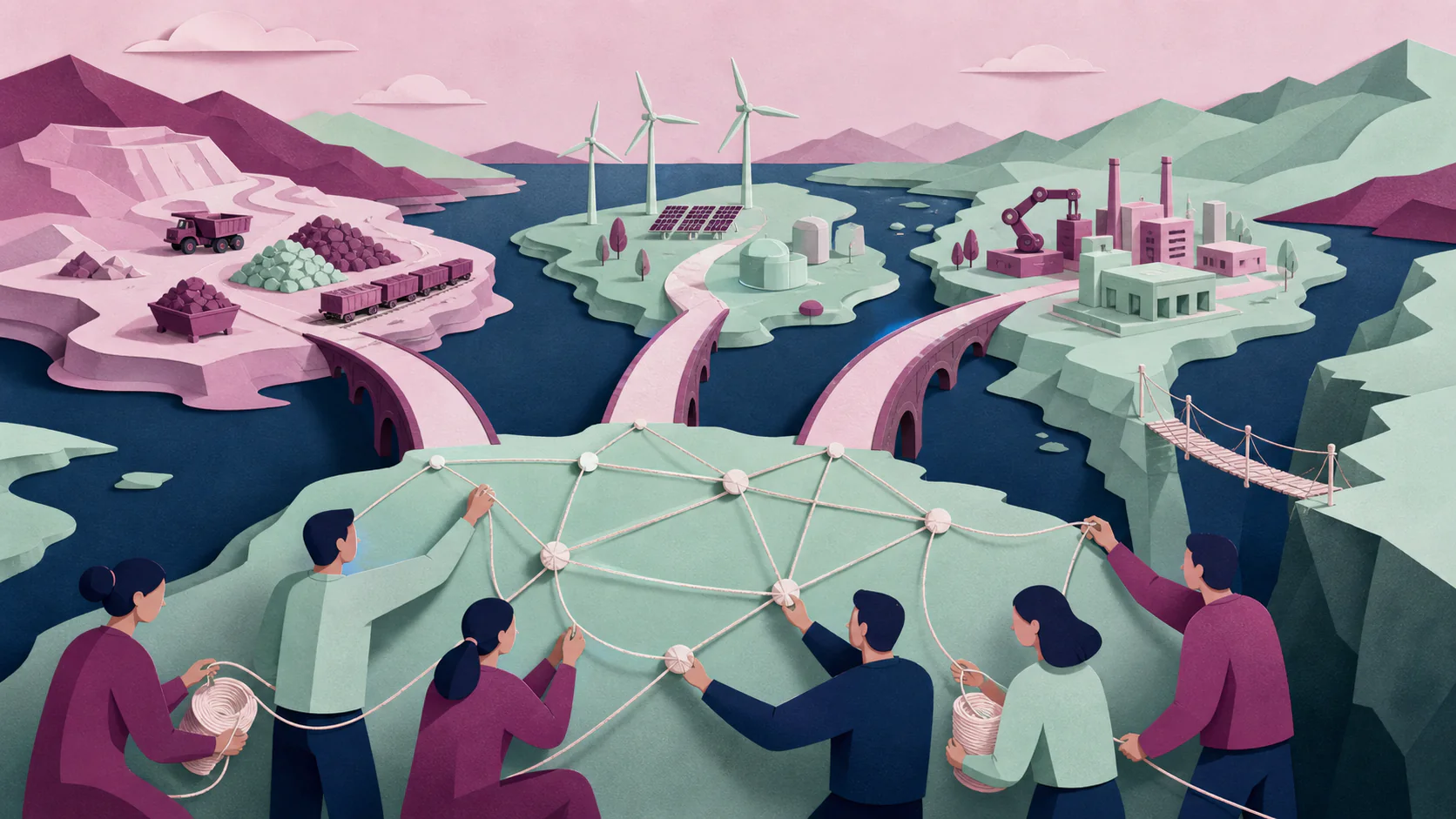
The final layer of the system is neither a chip nor an org chart. It is the ability to hold a conviction long enough to learn while allowing facts, colleagues, and consequences to correct the path.
That endurance carries a human cost. Acknowledging it does not turn suffering into virtue; it requires separating necessary difficulty, avoidable pain, and the relationships that make a long bet sustainable.
Jensen Huang rejects the opposition between conviction and vulnerability. A leader can defend a reasoned strategy without pretending to have always been right. Showing where doubt exists lets others contribute contrary information and makes a pivot possible before the leader’s status becomes inseparable from the decision.
Revision does not mean following every market mood. It tests the premises: does the problem remain important? Is the technology progressing? Has a decisive constraint changed? When the foundations hold, persistence remains rational; when they fail, posture must not replace them. Establish a reassessment cadence and ask explicitly which evidence should move the course.

Huang emphasizes what polished success stories often remove: doubt, loneliness, embarrassment, fear, and long periods without validation. Naming that cost prepares teams better than promising continuously joyful passion. A difficult bet may demand real sacrifice before it produces external proof.
Suffering, however, validates neither the idea nor the method. It may indicate an important problem, a badly designed organization, or a danger that should stop the work. A leader must distinguish inherent difficulty from avoidable pain, then reduce the latter. Treat human cost as a strategic risk: workload, recovery, psychological safety, and the ability to dissent must accompany ambition.

A conviction becomes strategic only when resources move before consensus. Huang describes a decade in which CUDA increased costs while the main market remained invisible. NVIDIA continued because the technical principles, emerging uses, and direction of computing remained coherent—not because the absence of customers counted as positive evidence.
Funding early therefore does not remove milestones. Write down the assumptions supporting the bet, the intermediate signals expected, and the evidence that would require stopping. Capital buys time to learn; it should not buy immunity from facts. Investment before applause is credible when it states in advance how conviction can be confirmed, corrected, or abandoned.

At the beginning, a small team may need to underestimate the size of a problem in order to attempt it. Huang describes a superhuman mindset without superhuman capability: enough confidence to begin before vulnerability, uncertainty, and the scale of the work become fully visible.
That productive ignorance is not enough to endure. Huang credits colleagues, cofounders, family, investors, and directors who did not abandon him through repeated crises. The Special therefore ends far from the lone-founder myth. Before making a long bet, build its human infrastructure too: people who can tell the truth, support beyond work, patient trust, and shared permission to ask for help.

The system behind NVIDIA is not a recipe to copy. It depends on a market, a team, a technical architecture, and a timescale few companies can reproduce. But its questions travel well: which problem deserves ten years, which weak signal earns investment, and which information remains trapped by hierarchy?
Choose one decision you keep postponing because the market is not ready. Write what would need to become true, the small market that could finance the wait, and the evidence that would make you abandon the conviction.
A long bet is not a motionless belief. It is a hypothesis that earns better reasons to survive each year.
Next on your journey
Two hand-picked recaps to take the ideas you just explored further.
 Entrepreneurship
Scale with Ouss · #1 · Oussama Ammar
65 lessons distilled from a 12-hour live stream.
 Entrepreneurship
Airbnb · 15 sources in dialogue
A company read through its decisions, critics, and consequences
Fifteen sources, 10 hours 28 minutes analyzed, and 52 lessons on design, safety, culture, cities, and accountability.
A question, correction, or partnership? contact@oolele.net
 Library